Few mythical creatures have endured in human imagination quite like the unicorn. Across centuries, artists have continually reimagined this legendary being—shaping its form, symbolism, and meaning to reflect the values and beliefs of their time.
From sacred medieval tapestries to modern fantasy art, unicorns reveal how creativity evolves alongside culture.
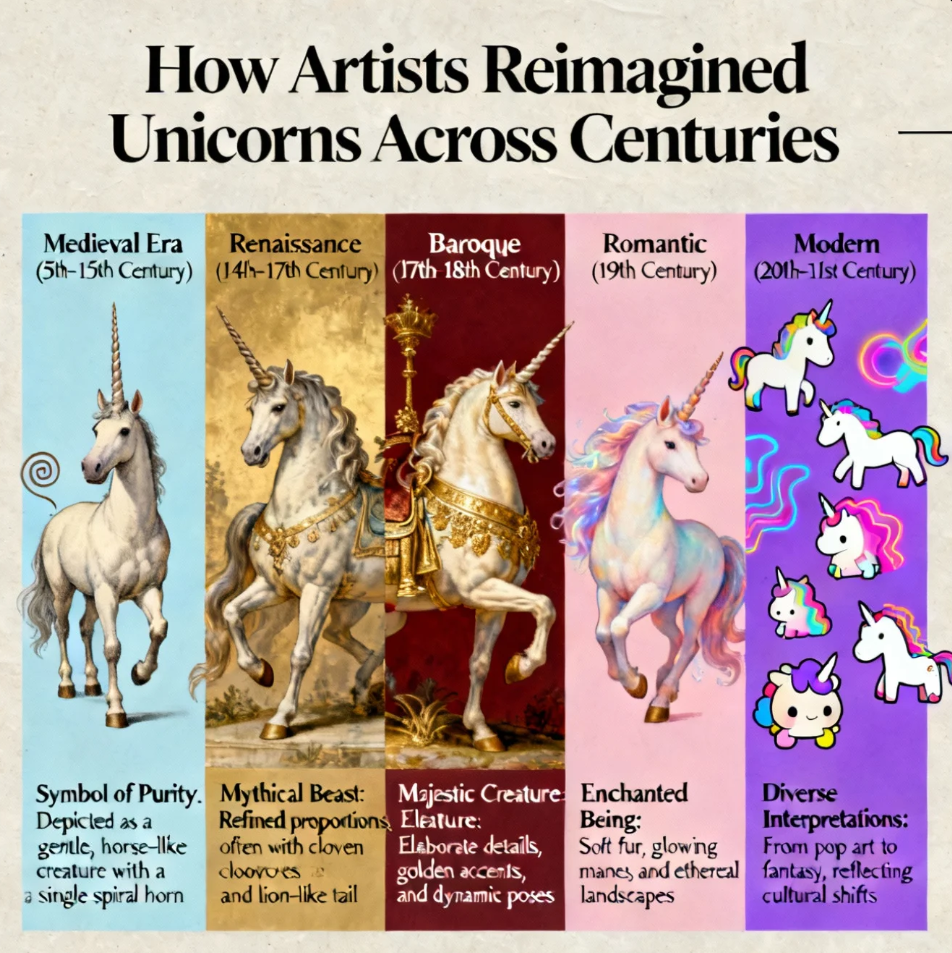
🏰 1. Medieval Unicorns: Symbols of Purity and Faith
In medieval Europe, unicorns were deeply symbolic:
- Often depicted as white, horse-like creatures with a single horn
- Associated with purity, chastity, and divine grace
- Frequently appearing in religious manuscripts and tapestries
Famous works like The Unicorn Tapestries portrayed the unicorn as both mystical and moral—a creature representing spiritual ideals rather than fantasy.
🎨 2. Renaissance Interpretations: Nature Meets Myth
During the Renaissance, artists began blending myth with observation:
- Unicorns gained more anatomically detailed features
- Artists combined elements of horses, goats, and deer
- Symbolism expanded to include love, nobility, and restraint
This era treated unicorns as part of a broader natural order, reflecting humanity’s renewed interest in science and realism.
🌿 3. Enlightenment and Decline: From Belief to Curiosity
As scientific thinking grew, belief in unicorns faded—but artistic fascination remained:
- Unicorns appeared less frequently in fine art
- They shifted from sacred symbols to mythical curiosities
- Illustrations often placed them alongside other “legendary beasts”
Artists used unicorns as imaginative remnants of folklore rather than objects of belief.
🧚 4. Romanticism and Fantasy Revival
The 19th century reignited unicorn imagery through emotion and imagination:
- Romantic artists emphasized mystery and wonder
- Unicorns symbolized innocence, freedom, and escape
- Fairy tales and illustrated literature revived their popularity
This period reintroduced unicorns as emotional and imaginative icons rather than moral symbols.
🌈 5. Modern and Contemporary Unicorns: Identity and Imagination
Today, unicorns are endlessly reinterpreted:
- Fantasy art portrays them as powerful, magical beings
- Pop culture embraces colorful, playful versions
- Digital art and media use unicorns as symbols of uniqueness and self-expression
Modern artists use unicorns to explore themes of identity, escapism, and creativity—proof that the symbol still evolves.
🔮 Final Thoughts: A Mirror of Human Imagination
The artistic journey of unicorns mirrors humanity itself. Each era reshaped the unicorn to reflect its beliefs—faith, curiosity, emotion, or individuality. Through art, unicorns remain timeless, reminding us that imagination adapts, transforms, and endures.
Unicorns aren’t just mythical creatures—they’re living symbols of how humans dream.