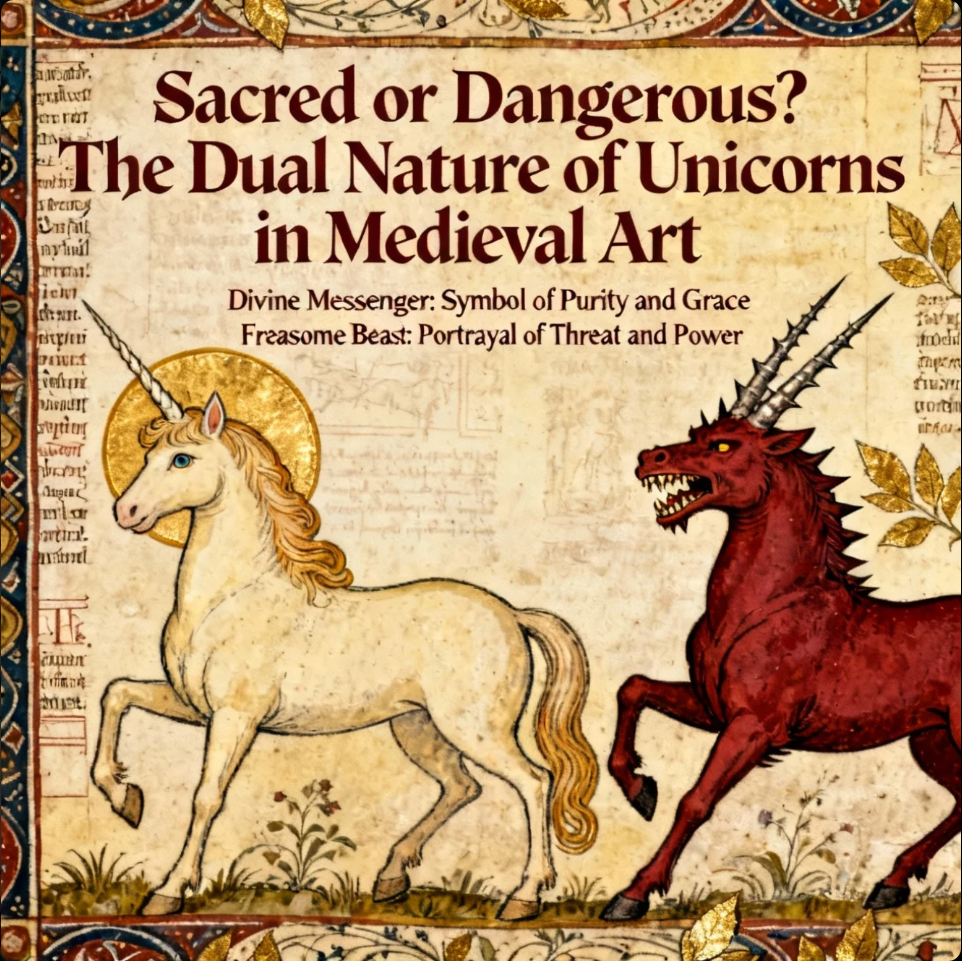
In medieval art, unicorns were far more complex than the gentle fantasy creatures we recognize today. Artists and theologians portrayed them as both sacred and dangerous, embodying purity, divine mystery, and Christ-like symbolism—while simultaneously representing untamed power, violence, and moral warning.
This article examines the dual nature of unicorns in medieval art, revealing how a single mythical creature carried contrasting meanings shaped by religion, folklore, and medieval worldviews.
The Sacred Unicorn: Purity and Divine Symbolism
A Christological Allegory
In Christian medieval thought, the unicorn often symbolized Christ himself. According to popular allegory:
- The unicorn could only be captured by a virgin
- The virgin represented the Virgin Mary
- The unicorn’s willing surrender symbolized the Incarnation
This sacred interpretation appeared frequently in illuminated manuscripts, church carvings, and devotional art, where the unicorn was depicted as calm, white, and gentle.
White coloring reinforced associations with:
- Moral purity
- Spiritual truth
- Divine innocence
🔗 Outbound link: The British Library – Medieval Bestiaries
https://www.bl.uk/collection-items/medieval-bestiaries
The Dangerous Unicorn: Power and Untamed Nature
A Beast of Strength and Violence
Contrasting with its holy image, medieval texts also described the unicorn as wild, aggressive, and lethal. Bestiaries portrayed it as:
- Impossible to capture by force
- Capable of killing hunters
- A symbol of raw, uncontrolled power
In visual art, this version of the unicorn often appeared:
- With sharp horns raised
- Charging enemies
- Isolated in wild landscapes
This dangerous aspect reminded viewers of the perils of pride, temptation, and unchecked desire.
🔗 Outbound link: Encyclopaedia Britannica – Bestiary Tradition
https://www.britannica.com/topic/bestiary
Why Medieval Artists Embraced the Contradiction
Moral Complexity Through Symbolism
Medieval art was designed to teach moral and spiritual lessons, often to an illiterate audience. The unicorn’s dual nature made it a powerful teaching tool:
- Sacred when approached with humility and purity
- Dangerous when pursued through violence or greed
This contradiction mirrored medieval Christian beliefs about:
- Divine grace versus human sin
- Spiritual purity versus worldly corruption
The unicorn became a visual paradox, reinforcing the idea that holiness and danger can coexist.
Unicorn Hunts in Medieval Imagery
Violence with Spiritual Meaning
The famous medieval motif of the unicorn hunt perfectly illustrates this duality. In tapestries and manuscripts:
- Hunters violently pursue the unicorn
- The unicorn fights back fiercely
- Its eventual capture carries religious symbolism
While visually brutal, the hunt was often interpreted as an allegory of Christ’s suffering and sacrifice—transforming violence into redemption.
🔗 Outbound link: The Met Museum – The Unicorn Tapestries
https://www.metmuseum.org/art/collection/search/467642
Artistic Style Reinforcing Dual Meaning
Gentle Form, Dangerous Power
Medieval artists emphasized dual symbolism through:
- Soft facial expressions paired with lethal horns
- Peaceful poses contrasted with violent narratives
- Sacred settings disrupted by moments of conflict
These visual contrasts ensured viewers understood that the unicorn was neither purely benign nor entirely monstrous.
Conclusion
Exploring the dual nature of unicorns in medieval art reveals a creature shaped by contradiction. Sacred yet dangerous, gentle yet violent, the unicorn embodied medieval humanity’s struggle to understand divine power and moral responsibility.
Far from simple fantasy, the unicorn served as a theological and moral symbol, reminding medieval viewers that purity carries power—and power, when misunderstood, can become perilous.