The unicorn, often imagined today as a whimsical fantasy creature, has a surprisingly deep and complex history rooted in early religious art and sacred texts. Long before it became a symbol of magic and innocence, the unicorn held powerful theological, moral, and symbolic meanings across Jewish, Christian, and even early pagan traditions.
This article explores how unicorns appeared in early religious art and texts, tracing their journey from ancient scripture translations to medieval Christian symbolism and sacred visual culture.
Unicorns in Ancient Religious Texts
Biblical Origins and Translation
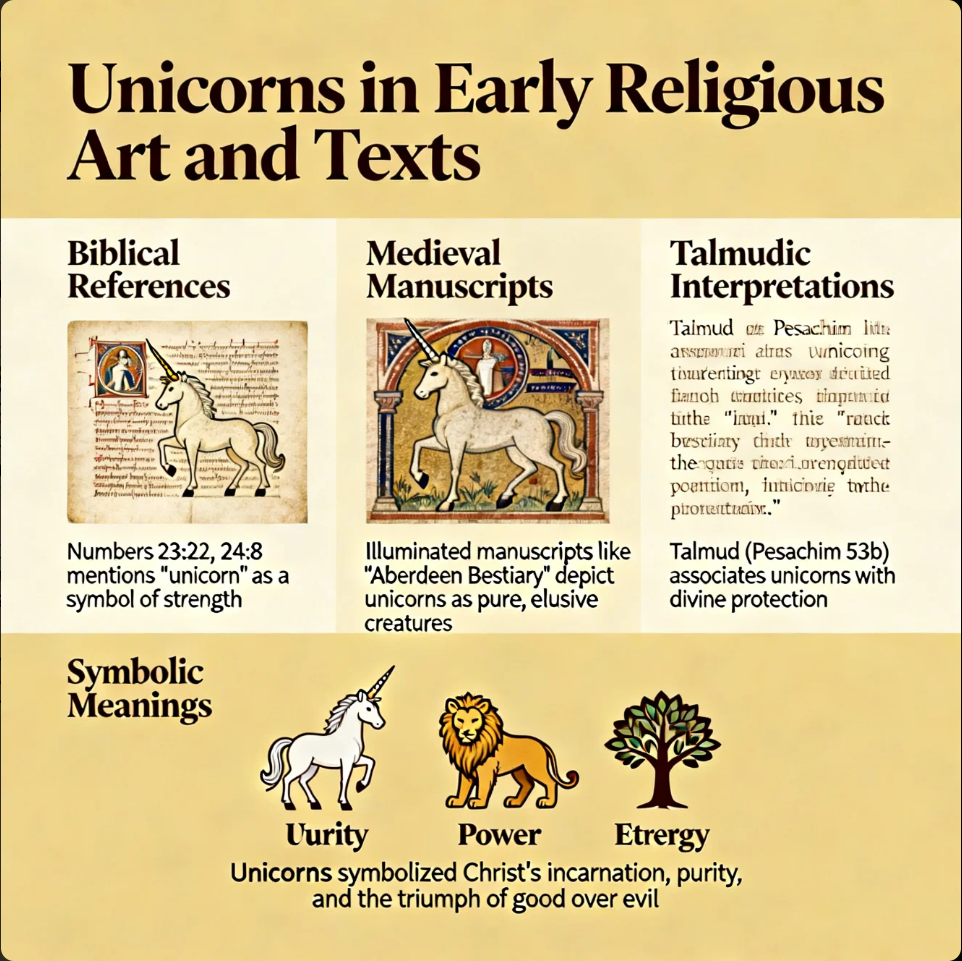
One of the earliest religious references to unicorns appears in ancient biblical translations. The Hebrew Bible mentions a powerful animal called the re’em, most likely referring to a wild ox (aurochs). However, when the Hebrew scriptures were translated into Greek (the Septuagint), re’em became monokeros, meaning “one-horned.”
Later, the Latin Vulgate Bible translated this term as unicornis, directly introducing the unicorn into Christian religious language.
“God brought them out of Egypt; he hath as it were the strength of an unicorn.” — Numbers 23:22 (KJV)
Although modern scholars agree the original animal was not mythical, these translations deeply influenced religious belief and imagery for centuries.
🔗 Outbound link: Encyclopaedia Britannica – Biblical Translation History
https://www.britannica.com/topic/biblical-literature
Unicorn Symbolism in Early Christianity
A Symbol of Christ and Purity
By the early Middle Ages, Christian theologians reinterpreted the unicorn as a Christological symbol. According to popular religious allegory:
- The unicorn represented Christ
- The virgin symbolized Mary
- The unicorn’s willing capture symbolized the Incarnation
This symbolism appeared in influential Christian texts such as the Physiologus, a widely circulated early Christian moral bestiary.
🔗 Outbound link: The British Library – Medieval Bestiaries
https://www.bl.uk/collection-items/medieval-bestiaries
Unicorns in Early Religious Art
Manuscripts, Mosaics, and Church Decoration
Unicorn imagery became common in religious manuscripts, tapestries, and church art between the 12th and 15th centuries. Artists portrayed unicorns in:
- Illuminated biblical manuscripts
- Church wall paintings and mosaics
- Devotional objects and tapestries
These images reinforced religious teachings about purity, sacrifice, and divine power.
One of the most famous examples is the medieval tapestry series “The Hunt of the Unicorn,” often interpreted as a Christian allegory of Christ’s suffering and resurrection.
🔗 Outbound link: The Met Museum – The Unicorn Tapestries
https://www.metmuseum.org/art/collection/search/467642
Jewish and Pre-Christian Influences
Myth, Power, and Sacred Authority
Before Christian reinterpretation, one-horned creatures already appeared in Near Eastern and Persian art, often symbolizing divine authority and strength. Jewish tradition viewed the re’em as a mighty, untamable beast—sometimes associated with God’s power rather than purity.
These layered cultural meanings helped shape how unicorns entered later religious storytelling and art.
🔗 Outbound link: Jewish Virtual Library – Biblical Animals
https://www.jewishvirtuallibrary.org/animals-in-the-bible
Why Unicorns Endured in Religious Tradition
Unicorns endured in religious contexts because they embodied qualities central to spiritual teaching:
- Moral purity
- Divine strength
- Sacrifice and redemption
- The mystery of faith
As literacy spread through religious art, unicorn imagery became a visual theology, teaching complex doctrines to largely illiterate populations.
Conclusion
Understanding how unicorns appeared in early religious art and texts reveals that they were never mere fantasy. Instead, unicorns functioned as powerful symbolic tools, shaped by translation, theology, and artistic tradition. Their presence in sacred art and scripture reflects humanity’s long effort to express divine truths through myth, symbolism, and imagination.