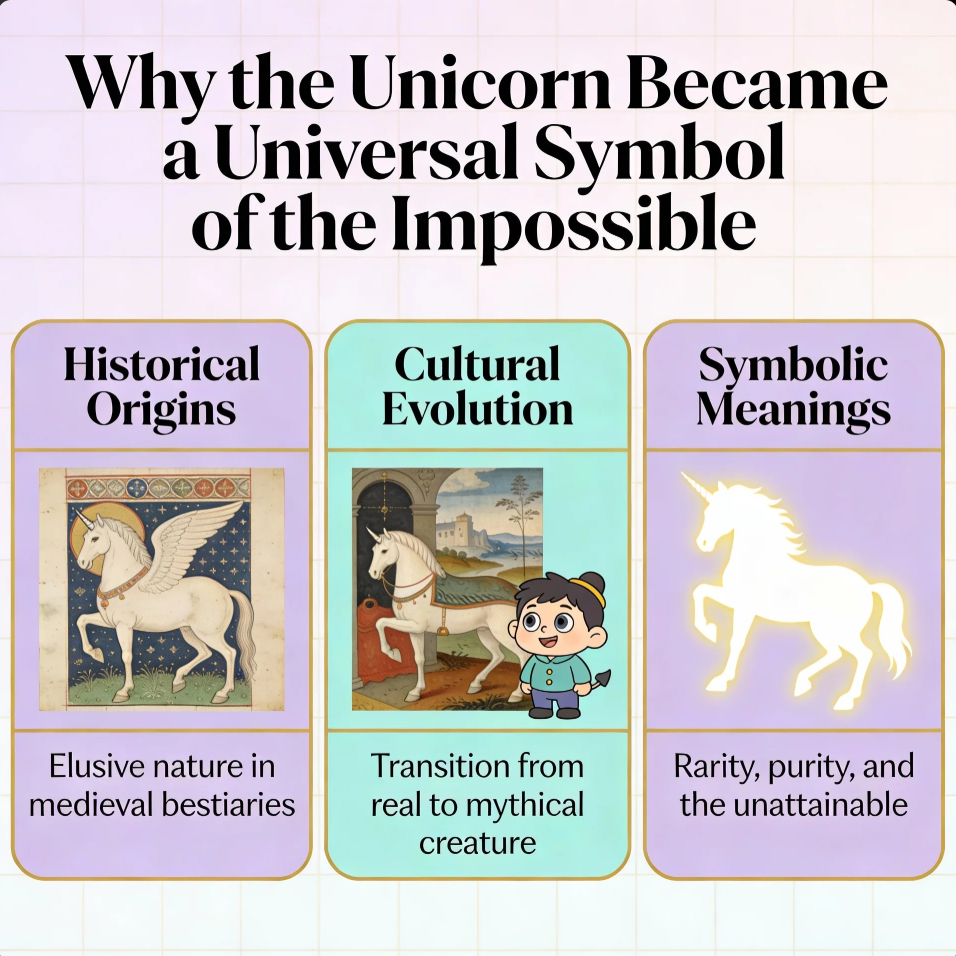
Across civilizations, centuries, and cultures, few mythical creatures have endured like the unicorn. Elusive, pure, and almost always just out of reach, the unicorn has become a universal symbol of the impossible—representing dreams that challenge reality and ideals that feel unattainable.
But how did this single creature come to embody the concept of impossibility worldwide?
Born from Rarity and Distance
Early descriptions of unicorns emerged from ancient travelers’ tales. Writers such as Ctesias described creatures from distant lands—India or Persia—that most people would never see. This geographical separation alone made the unicorn feel unattainable.
In a pre-globalized world:
- Distant lands equaled mystery
- Rare animals became exaggerated through storytelling
- Lack of verification allowed imagination to flourish
The unicorn became something believed in, yet never proven—the perfect foundation for an impossible symbol.
Purity as an Unreachable Ideal
In medieval Europe, unicorns were often associated with purity and moral perfection. Legends claimed they could only be approached by someone completely innocent, typically a virgin.
This symbolism reinforced impossibility:
- Absolute purity is rare, if not unattainable
- Moral perfection exists more as an ideal than a reality
- The unicorn could not be hunted, only invited
Thus, the unicorn represented ideals humans admired but could rarely embody.
The Unicorn and the Limits of Human Control
Unlike dragons or griffins, unicorns were not conquered or slain in most myths. They resisted domination.
This resistance mattered:
- Power could not force possession
- Desire alone was not enough
- Worthiness mattered more than strength
The unicorn symbolized the idea that some things cannot be taken—only earned or imagined.
Science, Reason, and the Disappearing Unicorn
As science advanced, belief in unicorns faded. Yet instead of disappearing, the unicorn evolved into a metaphor.
Once proven impossible:
- The unicorn shifted from creature to concept
- It represented what science could not deliver
- It became shorthand for “too rare to exist”
This transition cemented the unicorn as a symbol of dreams beyond logic.
Modern Culture and the Impossible Dream
Today, the unicorn thrives in modern language and culture:
- In business, a “unicorn” startup is valued over $1 billion
- In psychology, unicorns symbolize idealized love or perfection
- In art and media, they represent fantasy without limits
In every context, the meaning is consistent: extraordinary, rare, and nearly impossible.
Why the Unicorn Endures
The unicorn endures because humans need symbols for what lies just beyond reach.
It represents:
- Hope without certainty
- Imagination without proof
- Desire without guarantees
In a world driven by data and logic, the unicorn reminds us that not everything meaningful must be attainable.
Final Thoughts: The Beauty of the Impossible
The unicorn became a universal symbol of the impossible because it exists at the intersection of belief and doubt. It is rare, pure, unreachable—and therefore powerful.
By embracing the unicorn, cultures across the world acknowledge a timeless truth:
Some dreams matter most because they may never fully exist.